Positive Behaviour for Learning
Our school uses Positive Behaviour for Learning (PBL) – a whole-school approach for creating a positive, safe and supportive school climate where students can learn and develop. Our school community works together to establish expected behaviours and teach them to all students.
What is PBL?
Positive Behaviour for Learning (PBL) is an educational process that brings together the whole-school community to contribute to developing a positive, safe and supportive learning culture. The PBL framework assists schools to improve social, emotional, behavioural and academic outcomes for children and young people. When PBL is implemented well, teachers and students have more time to focus on relationships and classroom instruction.
What does PBL look like at Marrickville Public School?
Defining Expected Behaviour
MPS has identified three positive school-wide expectations that everyone – students, teachers, staff and parents – are asked to follow in all settings. Our school-wide expectations are:
- Be Safe
- Be Respectful
- Be a Learner
Teaching Expected Behaviours
It is crucial that expected behaviour is taught as rigorously as we teach academics through explicit instruction, practice, feedback and reteaching to increase the likelihood that students will follow the expectations. The school-wide expectations are explicitly taught. PBL lessons occur weekly on Monday afternoons, in all classrooms, and focus on the targeted positive behaviour expectation for that week.
A snapshot of the weekly school focus is also shared with parents and the community through MPS Matters Newsletter.
Encouraging Expected Behaviour
A school-wide acknowledgement system ensures all staff, students and parents/carers are aware of how student achievement will be acknowledged. It is important to note that not all students are encouraged by the same thing or in the same way.
-
‘Caught Being Goods’ are tokens known as ‘Waddles’ which are used school-wide by all staff to deliver specific positive feedback to all students. Waddles are collected in classes. Students can work towards Individual and whole class rewards.
-
Class Reward Systems reflect the school-wide expectations within the context of the class and stage. Class Dojo is an online-based reward system where individual students are assigned an avatar and given points for positive actions demonstrated by behaviour and academic performance.
-
Merit Awards weekly presentation of awards at a whole school assembly acknowledges positive behaviour and academic achievement. All teaching staff present two student awards for their class or support program at the fortnightly assembly each Tuesday afternoon. Names of students receiving awards are published in MPS Matters, the week prior to the assembly to further acknowledge this success with the school community.
MPS PBL Mascot 'Waddles'

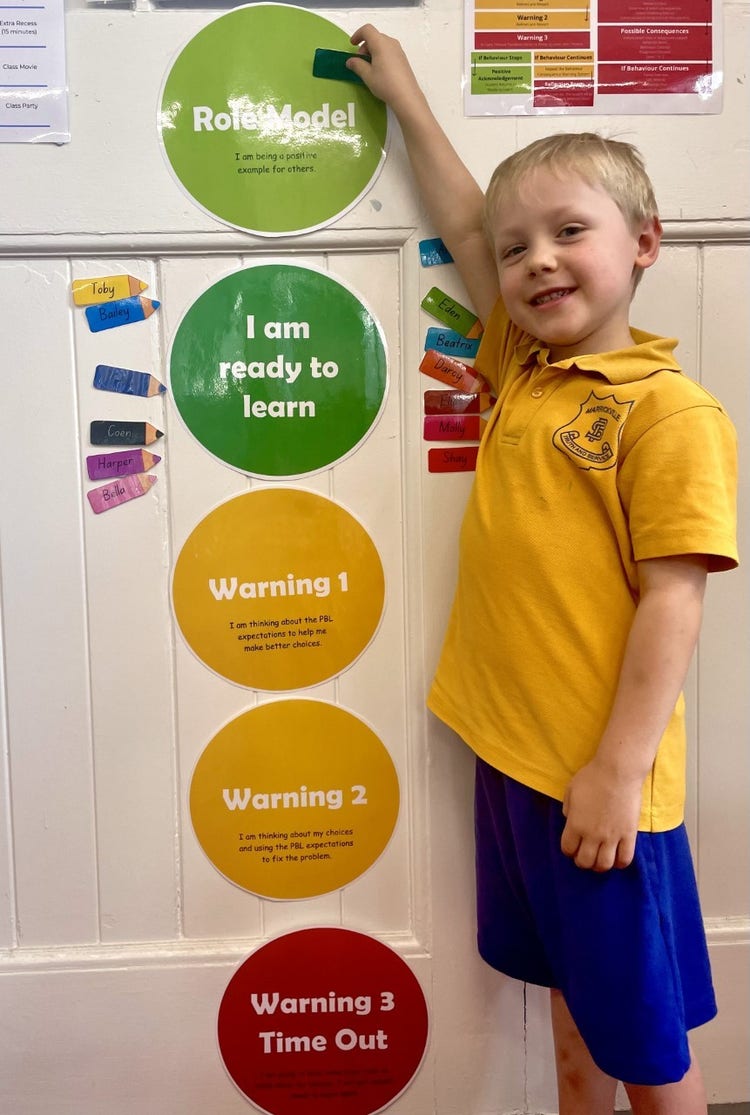
Classroom Student Behaviour Management posters
Responding to Inappropriate Behaviour
Establishing systems to respond to inappropriate behaviour is essential as it allows staff to efficiently and effectively respond to various behaviours, focusing on creating a positive learning environment for all students. Classroom teachers and executives are responsible for managing behaviour by establishing and negotiating clear expectations with students and addressing discipline issues promptly, fairly and respectfully (4.3).
At Marrickville Public School, negative behaviours are defined as Minor negative behaviours or Major negative behaviours. Staff refer to the Behaviour Code for Students and the school’s Student Behaviour Management Process to support the management of negative behaviour at school.
- Minor negative behaviours are managed by teachers. Teachers support improvement through re‐teaching, pre‐correction, corrective feedback and behaviour consequences if necessary.
- Major negative behaviours are managed at an executive level by the Classroom Teacher, Assistant Principals or Principal and may result in attending the Reflection Room during lunchtime. Parents will be contacted to discuss major negative behaviours.
In Class Time Outs
If a student receives 3 warnings within one session, the classroom teacher will direct students to a calm-down zone within the classroom. This is a 5-minute time out for students to reflect on their behaviour/choices. Students complete a stage-appropriate reflection sheet. After a 5-minute time out, students move their name back to ‘Ready to Learn’.
Reflection Room
An Assistant Principal attends the Reflection Room and meets with the student/s where they participate in restorative practice conversations.
- What happened?
- What were you thinking about at the time?
- What have your thoughts been since?
- Who has been affected by what happened?
- In what way have they/you been affected?
- What do you think you need to do to make things right?
- If the same thing happened again, what would you do differently?
Restorative Practice is a non-punitive approach that accepts that we all make mistakes and have the ability to ‘fix’ the problem together and learn from our experiences.
Have a question for our principal or teachers?
Our friendly office team can help you get in touch.
Learning
Find out about our approach to learning and supporting students to progress.
Travel to school
Learn about local transport options and how to get here safely.